Tuesday, December 27, 2011

Heroics in the Suburbs, with a View

Museum of Firefighters / Museo de Bomberos
12/27/11 – Calle Boada, 4
The weather this week, between Navidad and the holiday of Reyes, has been glorious.  On Tuesday morning, three generations (Grandpa, Dulcinea, Sons 1 & 2) set off by metro and emerged fourteen stations later at Buenos Aires.  I sense that few tourists make it out to see the free Museum of Firefighters, and that’s a shame.   

Fire truck, Museum of Firefighters
The location southeast of the city center is one of the attractions, we later learned.  As you walk north from the metro station, beyond a suburban superstore, a ramshackle courtyard on Calle Boada contains two old fire trucks and an unassuming entry door of corrugated tin.

Street view of the museum

Courtyard
Inside the dimly-lit but cavernous space, it smelled of gasoline and old machinery.  We were surprised to be greeted warmly by a fireman, who shook our hands in welcome.  He said that if we had any questions we should not hesitate to ask.  Another fireman was leading around a group of children and their parents. 


From a brochure I learned that the city of Madrid hired the first 24 firemen, then called “matafuegos,” way back in 1618.  The museum chronicles the history of firefighting in Madrid: old photos, vehicles, uniforms, communications equipment, extinguishers, ladders, helmets, nozzles and hoses of every shape and size.  Signage is minimal.


A chronology of nozzles
Practical, sculptural

The venerable FDNY, 1940s.
Red fire engines are the stars, with models from 1884 to 1949.  Several sported the distinctive, peaked "M" for Madrid on their front grills.

"M" for Madrid


Early vehicle, English-made, 1812

    The "Merry Weather," London, 1915
                  
After our visit, the boys made a beeline for the steep, grassy hill across the street.  It turned out to be part of a vast park, the Parque del Cerro del Tío Pío. They quickly returned for the camera, and entreated us to follow.  


Grandfather and S1, ascending hill

S2, ascending lamp post
At the top, a spectacular view of Madrid awaited:

Skyline, sierra and smog
The Museum of Firefighters led us to this place, and we felt lucky to see both.

Saturday, December 17, 2011

The Money Shot

Museum of Currency / Museo Casa de la Moneda
12/16/11 – Calle Doctor Esquerdo, 36

My Pericles obsession. Vatican Museum.
(Cameras allowed)
I was in the Rome last week, on my first visit to the Sistine Chapel.  Photographing Michelangelo’s masterpiece is strictly prohibited.  I feared a Japanese tourist might be drawn and quartered after she chose to disregard this edict.  Instead a guard yelled at her across the chapel, “NO!” 

I understand the reasons for no-camera rules, but what accounts for variation from museum to museum?  Some allow flash photos; others permit photos but no flash.  Some make you check the camera at the door.  Some let you carry but not use it, trusting that you won’t betray their trust.  Some museums don’t have a guard in every room, but watch you via secret camera.  A guard runs in to stop you, politely, the moment you withdraw the apparatus from your bag.  


Museum of Currency entrance (right)


50 reales
At Madrid’s free Museum of Currency, housed at the National Mint (Fábrica Nacional de Moneda y Timbre), the objects on display are too small for amateur photographs anyway. If you are over 40, bring reading glasses. The panther's head on a Greek coin became a crab when I took a second look. A notable exception: silver, coaster-size fifty reales coins from 17th c. Spain.  The museum presents the history of money in 17 rooms.  Items are described in Spanish only.  A huge collection of coins, medals, paper bills, machinery, and postage stamps represents every era.  Ostrogoths, Visigoths, and Vandals all struck their own metal coins on the Iberian peninsula.  During Islamic rule in Spain, coins held large amounts of text but no images. For the first time I saw actual “pieces of eight”; a United States three-dollar bill printed in 1776 in Philadelphia; a 6-shilling bill from the same year, printed in New Jersey; paper money from the French Revolution and the early years of the Russian Revolution; and a treasure chest (disappointingly empty).   

The bland euro, Spain's currency for now, can't hold a candle to the gorgeous coins of yore. 
________________
Until 12 February 2012, the Museum of Currency has a retrospective of Madrid artist Alfredo Alcain: “ALCAIN, MIRADAS SOBRE PAPEL. Retrospectiva gráfica 1969-2011.”  His work is both witty and accessible.  A poster is available at the information desk--no money needed.   

Saturday, December 10, 2011

Mousie from Madrid Will Take Your Teeth

House Museum of the Mouse Perez / Casa Museo de Ratón Pérez
12/10/11 – Calle Arenal, 8

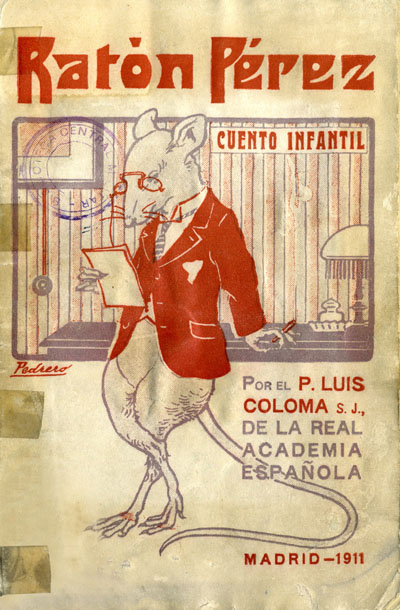
The U.S. has a tooth fairy, but children in Spain and many parts of Latin America expect an elegant rodent named Mousie Pérez to collect teeth from under their pillows and leave behind a gift.  The legend of Mousie Pérez—el ratoncito Pérez—was created in 1894 by a Jesuit named Luis Coloma.  Coloma wrote the story as a gift and moral guide for Spain’s 8-year-old King Alfonso XIII, or “King Buby,” as his mother called him.  In the story, the mouse takes the young King along on a nocturnal visit to the poorest neighborhoods of Madrid, so that Buby can witness the lives of less fortunate children. It's more of an adventure than a treacly tale, and the character of ratoncito Pérez has plenty of appeal.

Cover of first edition, 1911

Mousie Perez lives with Señora Pérez and children (Adolfo, Elvira, and Adelaida) in a Huntley’s biscuit box in the basement of the Carlos Prast confectionery, at number 8 Calle Arenal.  The building still stands today, on a busy pedestrian street just steps from Puerta del Sol and the Royal Palace.  

Former Prast confectionery
In 2003, the city of Madrid paid homage to the mouse by placing a plaque and a tiny bronze sculpture just inside the doorway.  


Upstairs, a rather gaudy, one-room museum trades on the Mousie Pérez legend.  It sells trinkets, including a facsimile of Coloma’s book (8 euros).  For 1 euro, children and their parents enter a second room and gather around a cross-section of the Pérez family’s biscuit-box, to listen to a guide tell stories about the famous mouse.  

Pre-teen in front of House Museum of Mousie Perez
On this foggy Saturday morning a few weeks before Navidad, the stairwell was thick with families.  The museum allows 30 visitors at a time, and the next available tickets were for 7:30 p.m., a full seven hours later.  I’d brought along Son 2 for company. He's 12, and still has some baby teeth and an interest, albeit waning, in talking animals--though only when they are engaged in mortal combat. Still, I knew what I had to do in order to see the tooth of Beatrix Potter.  I sent my dear boy outside, and brazenly talked my way into the exhibit for a brief look around.  

My readers will be surprised to know that the teeth of several luminaries in addition to Ms. Potter are on display: Isaac Newton, Marie Curie, Edith Piaf, Louis Pasteur, Beethoven, Rosalia de Castro, and… Miguel de Cervantes.  I smelled a rat.  But no, the pleasant guide told me, “Ratón Pérez told us these are their teeth, and we can only take his word for it.”  She looked at me as if to say, these walls have ears.

Back outside in the throbbing heart of Madrid, the line to buy lottery tickets for El Gordo, the Big One, stretched across the Puerta del Sol.  A motley Sponge Bob, looking a bit unlicensed, tried to interest passersby in a photo with him, for a small fee. 


And then we saw a frozen flash mob, row upon row of people standing still, looking mournful, and holding the carcasses of small animals in their outstretched hands. 


The group Igualdad Animal, an animal equality organization, was holding a protest.  It certainly caught our attention.  Son 2 was thoughtful.  “I hope that’s not Ratón Pérez,” he said, with a glint in his eye.

Sunday, November 27, 2011

Surprise in the Water Tower

Sala Canal de Isabel II
11/26/11 - Calle Santa Engracia, 125

I'd been eying the structure for months, and finally learned its purpose.  The defunct water tower built in 1911 looms over the Canal of Isabel II.  

The Sala Canal de Isabel II

In the 1980s, the circular tower was remodeled inside and took on a new function as a multi-level sala, or hall, for modern photography exhibitions.  The other day I dragged the protesting progeny to the excellent free exhibit “Juan Gatti. Contraluz.”  Do bring a passport or other form of ID to enter the complex; a guard will sign you in at the entrance on Calle Santa Engracia, 125. 


Gatti, an Argentinian graphic artist and photographer, moved to Madrid in 1980, at the beginning of the post-Franco flowering of art and culture known as La Movida.  He found work in Spanish fashion and film, and designed many of the colorful posters for Pedro Almodovar’s movies.  The first level of the exhibit contains Gatti’s inventive commercial work, including Vogue covers and portraits of celebrities.  The remaining 3 levels display his black and white photography on a grand scale.  A trippy, multi-media treat awaits you on the top level, as you sit back on a comfy lounge chair under the water tower’s dome.  My fifteen-year-old enjoyed it so much he stayed for a second viewing.  

They liked it! (Tower entrance)
 The exhibit “Juan Gatti. Contraluz” runs daily until 1 April 2012.

Wednesday, November 23, 2011

Barefoot Nuns, Eyeballs on a Dish

Monastery of the Barefoot Noblewomen / Monasterio de las Descalzas Reales
11/22/11 – Plaza de las Descalzas, 3

Before it became a refuge for five centuries of barefoot nuns, the Monasterio de las Descalzas Reales was a medieval palace of the famously inbred Habsburg royal family.   

Tour entrance at left
Joan of Austria was born in here in 1536.  She was married to a double first cousin in Portugal, who impregnated her and then promptly died.  Joan was called back to Madrid in 1554 by her brother King Phillip II, to rule for him while he lived in England, leaving her baby (named Sebastian—an uncommon moniker at the time) to be raised in Portugal.  She never saw Sebastian again.  In 1559, Joan turned the palace into a convent for women of the royal household, including herself.  She remained single and died at age 38.  Today about 20 nuns reside in the convent unseen, their choice of footwear unknown.

Joan of Austria, age 25


The Monasterio (nun = monja in Spanish) is located close to the center of Madrid.  If you arrive at 11 and can’t get a tour until noon, there are dozens of nearby distractions, including Starbucks and the Chocolatería San Ginés. The building was designed early in the 16th century by royal architect Juan Bautista de Toledo (see my report on the Musem of the Sewers of Peral).  The hour-long, guided tour in Spanish (and perhaps in English, when there are enough takers) costs 7 euros.  The guide speaks very quickly, and lot of basic information is covered, but not what one really wants to know. Where are the nuns? What do they do all day?  Why are there two separate paintings of girls holding dishes of eyeballs?  

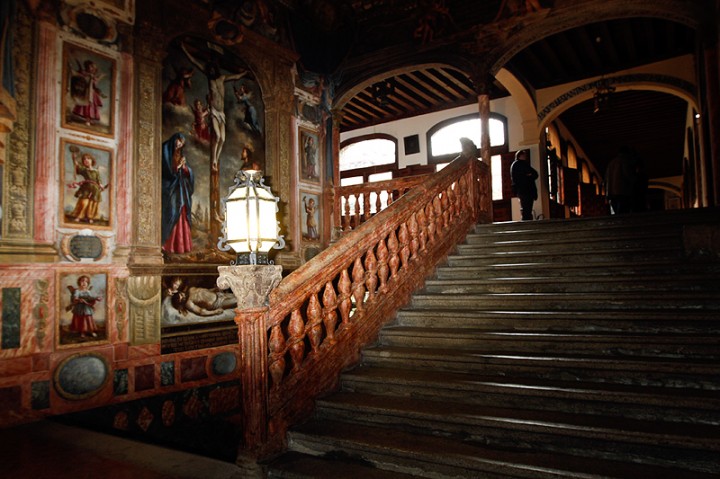
Even if you don’t speak a work of Spanish, it is well worth tagging along to inhale the medieval atmosphere: the staircase frescos, family portraits, religious treasures, tiny chapels, and a vast chamber of floor-to-ceiling tapestries based on designs by Rubens. 
 
Main staircase leading to cloister

Over the centuries, the dowries of noblewomen enriched the convent’s art collection. The most valuable painting here is Caesar’s Money, by Titian.  As for the eyeballs, a quick search of religious symbology in gothic art suggests that the eyeballs are held by Saint Lucy (283-304), a wealthy young girl whose eyes were gouged out as punishment for steadfastly guarding her virginity and refusing to marry a pagan. A fitting subject for a convent of recluses.

The shiny brick floor of the cloister is not original, but the Talavera tiles that line the walls and chapels are authentic, and beautiful.  The cloister on the second floor looks down upon a symmetrical garden of orange trees and a fountain. One fully expects a unicorn to canter by. 

Monday, November 21, 2011

Yves Saint Laurent, Out and About

Fundación Mapfre: Yves Saint Laurent Retrospective
11/20/11 – Paseo de Recoletas, 23

November turns out to be a wet month in Madrid.  Every bar along the street glows invitingly.  It’s not cold by midwestern standards, but dogs are wearing sweaters, and prams navigate the sidewalks like barges, their tiny passengers snug under clear plastic rain shields.  Even on a rainy Sunday there’s plenty to do.  Mapfre—a Spanish insurance company that sponsors cultural exhibits on a regular basis—is hosting a free retrospective on the influential French fashion designer Yves Saint Laurent (1936-2008).   

1965
The precocious Saint Laurent took over the House of Dior in Paris at age 21.   He popularized the trapeze dress, safari jacket, tuxedo suit for women, and see-through evening wear.  He scandalized the critics in 1971 with clothes reminiscent of prostitutes in Nazi-occupied Paris.  Saint Laurent was also the first designer to use ethnic models in his runway shows.   

There is little here about Yves the man. His disastrous experience in the French army during the Algerian war of independence, his addictions, and his private life are not on display.  A replica of his modest work-table and studio shows only a few of Saint Laurent’s obsessions—a passion for art, and for his French bulldog “Moujik” (as documented by Andy Warhol, below).


Though he rarely traveled beyond his villa in Morocco, Saint Laurent drew inspiration from world cultures.  I’m old enough to remember the splash he made in 1976 with his Russia-inspired collection.  


When I arrived in Moscow in 1985, I think I expected to see Russian women dressed like that; in reality, the economy dictated a wardrobe of soviet drab—with the exception of fur hats, whose exuberance exceeded anything Saint Laurent could conjure.  The lower floor of the exhibit chronicles the creative process, with four decades of Saint Laurent’s sketches and fabric samples.  How dispiriting to see in detail the rise and fall of 1980s shoulder pads.  During the flower of my youth, styles were so awful.  And now Spain won’t let me forget: the 1980s gem El Coche Fantástico (Knight Rider, starring David Hasselhoff) plays daily on Spanish television.  

On Sunday evening I saw “The Help” at Cinema Verdi, one of the few theaters in town that shows foreign movies with subtitles instead of dubbing.  The American South has always seemed like another country, and in this film, set on the brink of the Civil Rights era, it’s truly alien.  Ladies of the Junior League wear hometown versions of Dior’s “New Look,” their waists still as girdled as their outlook on life.  I find myself wondering about attitudes toward race in Spain.  During “The Help,” there were sniffles all around. Some things are universal.  

The Yves Saint Laurent Retrospective runs until 8 January 2012. 

Saturday, November 12, 2011

Art, Where Beer Once Brewed

ABC Museum of Drawing and Illustration / Museo ABC de Dibujo y Ilustración
11/12/11 – Calle Amaniel, 29-31


The ABC Museum is so new that the image on Google Maps shows a façade still covered in graffiti.  Architects have remodeled this 1900 building (the first Mahou beer factory in Madrid) inside and out.  Except for one wall of red brick, not a hint of brewery remains.  Tucked into a narrow side street, the remodeled exterior succeeds.  The courtyard has a cool, shattered-pavement vibe.  

ABC Museum courtyard


Street view


Inside, the walls are white, and sparsely covered.  Though the museum boasts in its literature of a permanent collection, the galleries are reserved for temporary shows.  The latest exhibit, “The Elegance of the Drawing: Chronicle of Paris,” is a straight-forward presentation of over 700 fashion illustrations by Carlos Sáenz de Tejada during his time in the City of Light, 1931-36.  Docents were leading groups of 5-year-old tots and their parents through the exhibit, part of the museum’s Saturday programming for families.  Given the subject matter, the attention span of these children was most impressive. 

Exhibit space, "The Elegance of of the Drawing"


A Spaniard born in Tangier in 1897, Tejada started out as an avant-garde painter and designer for the theater, but in 1926 switched to a more practical career.  Later in life, he taught drawing and illustration at the School of Fine Arts in Madrid, where he died in 1958.  The coveted “look” for women throughout the 1930s was long, languid, and decidedly glam.  Tejada worked for the most prestigious fashion designers and magazines of his time.   

I'd wear it!

Tejada liked to include dogs


Tejada’s illustrations also appeared in American newspapers, such as the New York American (“A Paper for People Who Think”).  The culture page for 16 April 1931 features an illustration by Tejada under the banner “Frock of Shimmering Silver Cloth Is Sterling Spring Choice for Wear in Evening.”  The rest of the page contains some fascinating distractions—including enlightened advice, doled out by Arthur Dean, Sc.D., Parents’ Councelor [sic], for the parents of teen daughters who stay out dancing until 4 o’clock in the morning and return home in the cars of unknown young men.
 
After viewing the exhibit, I stopped in at J & J Books and Coffee, a few blocks away on Calle Espirito Santo, 47.  The cellar is lined with shelves of used paperbacks in English, the largest collection I’ve seen yet in Madrid.  Three battered copies of Eat, Pray, Love!  Upstairs at the coffee bar, an English gent bemoaned the price of doing business in Spain, while an American woman with an MBA nodded in sympathy.  In a corner, an older woman conversed with a large dog.  I left with Sue Grafton and Curtis Sittenfeld in my bag.  Every so often, we all need to wag the mother tongue.  

The exhibit “La Elegancia del Dibujo” runs until 26 February 2012.