Showing posts with label Monastery of the Barefoot Noblewomen. Show all posts

Friday, May 11, 2012

It's a Bloody Mystery


Royal Monastery of the Incarnation / Real Monasterio de la Encarnación
05/11/12 – Plaza de la Encarnaci
ón

The Royal Monastery of the Incarnation was established in 1611, a few years after the Monastery of the Barefoot Noblewomen.  In olden times, a passageway from the nearby Royal Palace allowed the royal family to visit and worship at their convenience. The monastery conducts 1-hour guided visits in Spanish. 
  
Royal Monastery of the Incarnation

The guide told us that 10 nuns still live in the cloister today, hidden from view.  A revolving wooden counter set in an interior wall--identical to the “torno” for convent sweets at the Convent of Corpus Christi--functions as their portal of communication with the outside world.  How I would like to interview one of those nuns, or at least send a list of written questions through the wall!  

What's it like to never leave?
As the guide whisked us from room to room, she pointed out religious figures in time-darkened paintings; statues of the virgin wearing real outfits of embroidered silk; and the royal visages of Spain’s pallid, pursed-lipped Austrian monarchs.  At one point the guide chastised a hapless man who strayed several meters from the group.  Perhaps he too was trying to get a glimpse of a living being amongst the Stations of the Cross.  The windows onto the courtyard, it turns out, have opaque glass.  
 
The paintings and sculptures are not as impressive as those in the Monastery of the Barefoot Royals, and the rooms are not as lavish. My favorite painting showed a nun laid out in her coffin, covered in flowers; the guide said it was a rare illustration of the convent’s funerary tradition.  A huge painting of a biblical wedding scene shows a banquet table laden with empanadas. A life-sized 17th century sculpture by Gregorio Fernandez, of the reclining Christ covered in blood, is all too realistic.  The final station for our group, a room chock full of saintly relics, might be worth the price of admission (7 euros).  


St. Pantalemon, usually portrayed as a mop-top

From floor to ceiling, the walls are lined with artfully displayed bone chips, the arms of eight martyrs, and the leg of St. Margaret.  A reliquary with a glass orb contains the solidified blood of St. Pantalemon, a Christian healer from the early fourth century.  According to legend, he was tortured mercilessly and then beheaded for performing miracles on sick people instead of treating them in the normal way—normal for Greek doctors in the year 303 CE, that is.  

Every year on July 27, the day of St. Pantalemon’s death, the reliquary is carried to the Baroque church next door and displayed to the public, as well as broadcasted on closed-circuit TV monitors.  On that day only, the blood in the orb is said to turn from a solid to a liquid before your eyes.  As luck would have it, we leave Madrid for home on July 27, and will not be here to see it.

Wednesday, November 23, 2011

Barefoot Nuns, Eyeballs on a Dish

Monastery of the Barefoot Noblewomen / Monasterio de las Descalzas Reales
11/22/11 – Plaza de las Descalzas, 3

Before it became a refuge for five centuries of barefoot nuns, the Monasterio de las Descalzas Reales was a medieval palace of the famously inbred Habsburg royal family.   

Tour entrance at left
Joan of Austria was born in here in 1536.  She was married to a double first cousin in Portugal, who impregnated her and then promptly died.  Joan was called back to Madrid in 1554 by her brother King Phillip II, to rule for him while he lived in England, leaving her baby (named Sebastian—an uncommon moniker at the time) to be raised in Portugal.  She never saw Sebastian again.  In 1559, Joan turned the palace into a convent for women of the royal household, including herself.  She remained single and died at age 38.  Today about 20 nuns reside in the convent unseen, their choice of footwear unknown.

Joan of Austria, age 25


The Monasterio (nun = monja in Spanish) is located close to the center of Madrid.  If you arrive at 11 and can’t get a tour until noon, there are dozens of nearby distractions, including Starbucks and the Chocolatería San Ginés. The building was designed early in the 16th century by royal architect Juan Bautista de Toledo (see my report on the Musem of the Sewers of Peral).  The hour-long, guided tour in Spanish (and perhaps in English, when there are enough takers) costs 7 euros.  The guide speaks very quickly, and lot of basic information is covered, but not what one really wants to know. Where are the nuns? What do they do all day?  Why are there two separate paintings of girls holding dishes of eyeballs?  

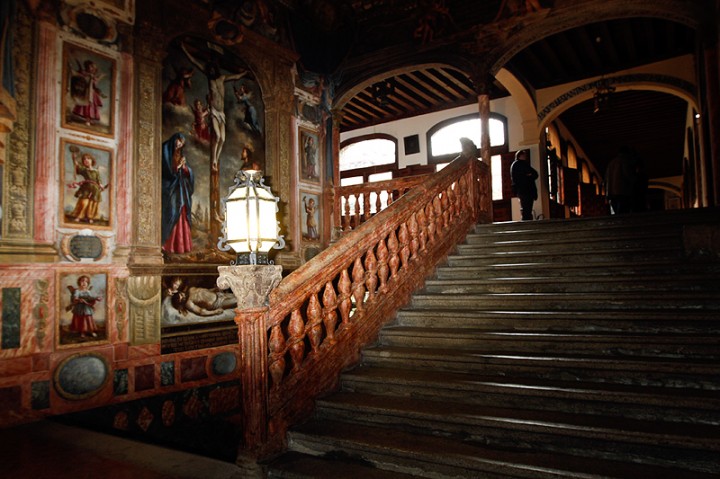
Even if you don’t speak a work of Spanish, it is well worth tagging along to inhale the medieval atmosphere: the staircase frescos, family portraits, religious treasures, tiny chapels, and a vast chamber of floor-to-ceiling tapestries based on designs by Rubens. 
 
Main staircase leading to cloister

Over the centuries, the dowries of noblewomen enriched the convent’s art collection. The most valuable painting here is Caesar’s Money, by Titian.  As for the eyeballs, a quick search of religious symbology in gothic art suggests that the eyeballs are held by Saint Lucy (283-304), a wealthy young girl whose eyes were gouged out as punishment for steadfastly guarding her virginity and refusing to marry a pagan. A fitting subject for a convent of recluses.

The shiny brick floor of the cloister is not original, but the Talavera tiles that line the walls and chapels are authentic, and beautiful.  The cloister on the second floor looks down upon a symmetrical garden of orange trees and a fountain. One fully expects a unicorn to canter by.